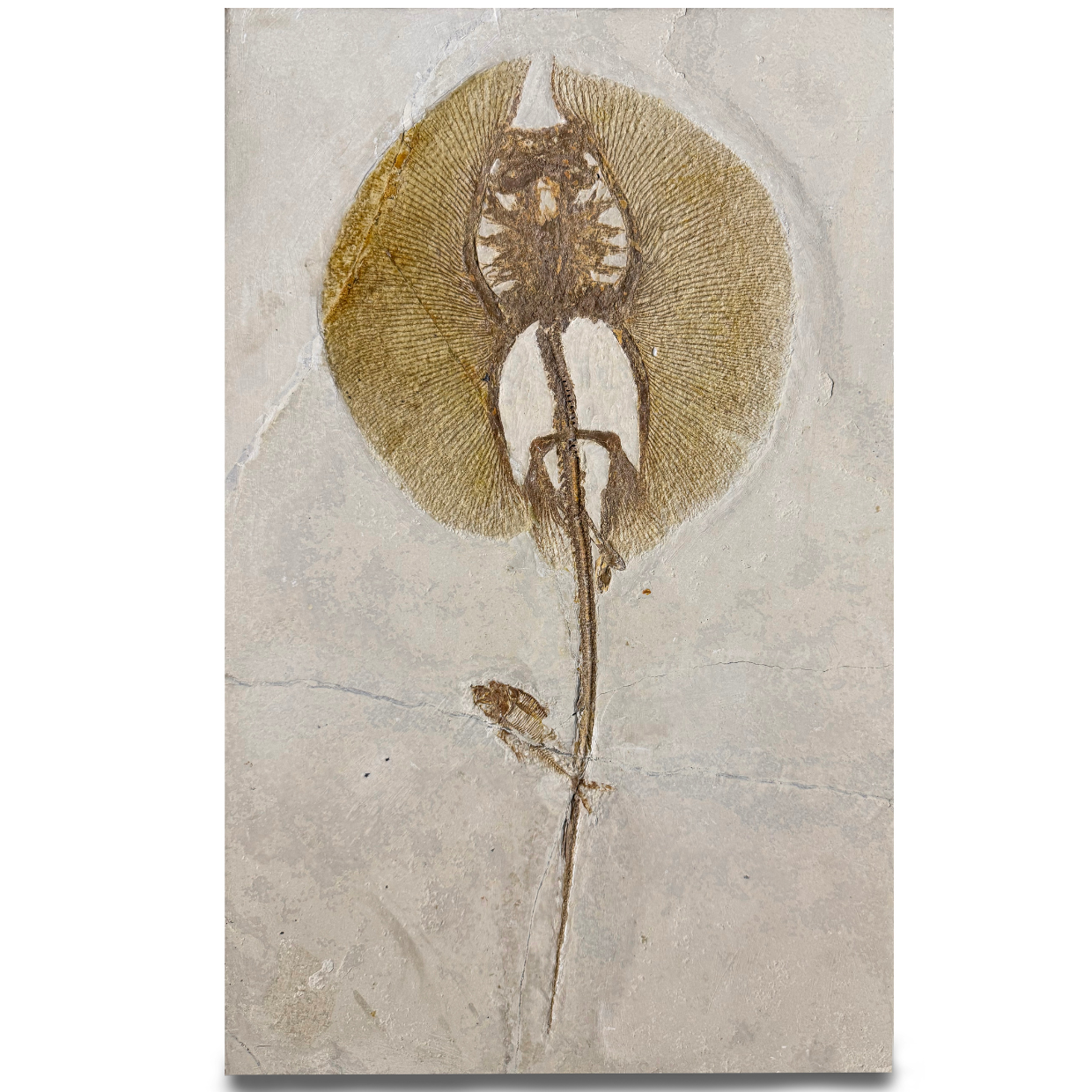


Stingrays with Fish | Wyoming, USA
Stingrays with Fish | Wyoming, USA
Couldn't load pickup availability
- Origin: Wyoming, USA
- Age: Eocene, approximately 50 million years old
- Size: L45.4cm H28.5cm D2cm
- Fossil length: 41 cm
Description: Rays (Batoidea) represent an extremely diverse lineage of cartilaginous fish, whose characteristic body plan reflects a strong adaptation to life on the seafloor. Within this group, stingrays (order Myliobatiformes) are among the most species-rich taxa, comprising more than 360 living species across 11 families. Although their evolutionary relationships remain a subject of scientific debate due to differing interpretations of molecular and morphological data, stingrays are generally recognized as a monophyletic clade defined by a series of derived anatomical features. These include one or more serrated caudal spines, a secondary (thoracolumbar) synarcual, the absence of a rostral cartilage, and specialized features of the gill arches and pectoral girdle.
• Additional information: The fossil record of stingrays extends back to the Early Cretaceous but is unevenly preserved. As with other cartilaginous fish – sharks, rays, and chimaeras – their skeletons rarely fossilize, so the majority of fossil material consists of isolated teeth, denticles, and occasional fin elements. Completely preserved, articulated stingray skeletons are therefore extraordinarily rare and largely restricted to selected Cenozoic deposits.
Batoidea rays are considered a group whose origins lie in the Mesozoic Era, possibly arising concurrently with the early radiation of neoselachians. Teeth attributed to rays already appear in the Early Jurassic and, despite the inherent limitations of the fossil record, provide important clues to the early evolutionary history of this remarkable group.